


Pick a corset whose internal waist runs 3 to 6 inches smaller than your natural waist. If your natural waist is 32 inches, choose a 28-inch corset for a solid 4-inch reduction. Off-the-rack corsets usually list this internal waist measurement right on the product page, and if the numbers ever confuse you, Room24’s fit support can walk you through it.
Key Takeaways
Correct corset sizing depends on subtracting your desired waist reduction from your natural waist measurement, then checking rib spring, hip spring, and torso length against the specific style.
| Point | Details |
|---|---|
| Core sizing formula | Subtract your chosen reduction (3 to 8 inches) from your natural waist to find your corset size. |
| Measure five key areas | Take natural waist, underbust, high hip, bust, and seated torso length for a full profile. |
| Match reduction to experience | Stick to 3 to 4 inches if new, 5 to 6 for moderate shaping, and save 7 to 8+ for experienced wearers. |
| Check spring and length, not just waist | Rib spring, hip spring, and torso length determine whether a matching waist size actually fits. |
| Use Room24 for fit questions | Room24’s size guide and support team help match your measurements to ready-to-wear corset sizes. |
Table of Contents
- How Do You Calculate Your Corset Size?
- What Measurements Do You Need to Take?
- How Much Waist Reduction Should You Choose?
- What Are Rib Spring and Hip Spring?
- Why Won’t My Corset Close, Gap, or Sit Right?
- Should You Buy Off-the-Rack or Order Custom?
- Tailoring Standard Sizes for Asymmetry and Special Cases
- How Should You Measure for Underbust vs. Overbust Styles?
- Getting Fit Right Comes Down to Patience, Not Guesswork
- Ready to Shop Your Size?
- Frequently Asked Questions
- Sources
How Do You Calculate Your Corset Size?
The math is simple: measure your natural waist, decide how much reduction you want, then subtract. Natural waist minus reduction equals the corset size you shop for.
Here’s how that plays out with real numbers.
- Mild reduction: 30-inch waist minus 4 inches equals a 26-inch corset. This gives gentle shaping without much sensation.
- Moderate reduction: 34-inch waist minus 6 inches equals a 28-inch corset. This produces a noticeable hourglass curve.
Corset Database’s sizing calculator recommends 3 to 4 inches of reduction for mild shaping, 5 to 6 inches for a moderate silhouette or waist training, and 7 to 8 inches only for wearers with real experience.
If your measurement lands on a quarter inch, round to the nearest half or whole inch rather than chasing false precision. OTR sizing isn’t built for that level of detail, and rounding up slightly, rather than down, keeps you from ordering something that closes too tight on the first wear.
What Measurements Do You Need to Take?
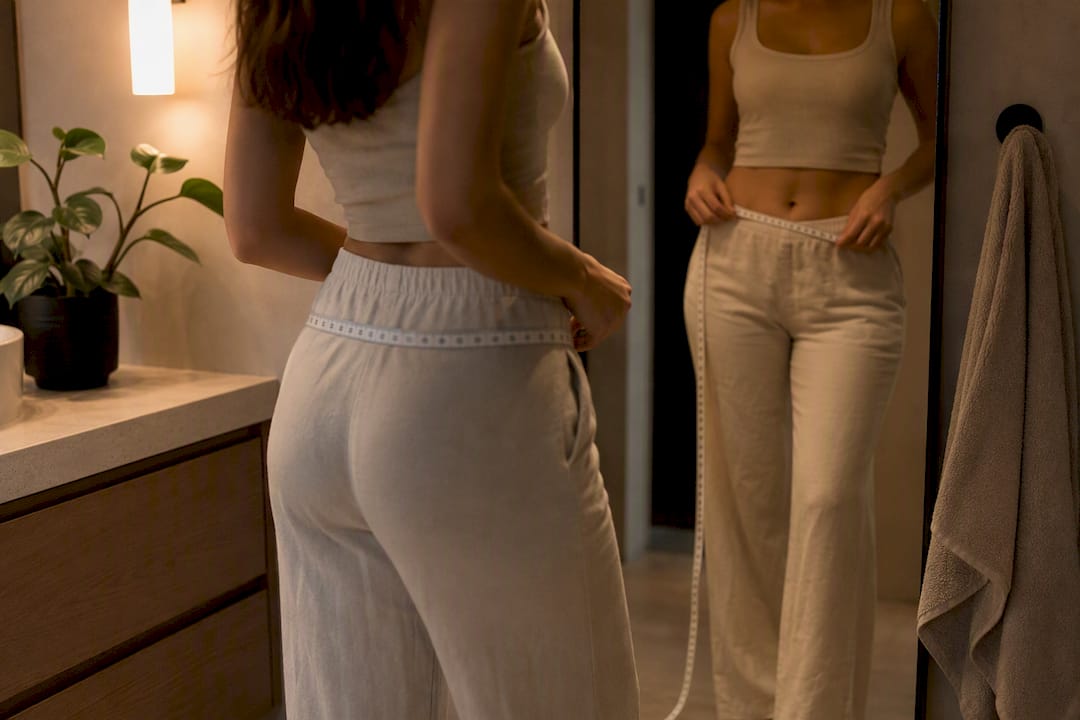
Grab a soft fabric tape measure, stand in front of a mirror, and wear something thin and fitted, a t-shirt or nothing at all. Skip bulky sweaters. They’ll throw off every number.
- Natural waist: Find the narrowest point of your torso, usually just above the belly button, and wrap the tape snugly without pinching skin. French Meadows notes that if you don’t have a clear waist crease, measure one inch above your belly button instead.
- Underbust: Wrap the tape directly under your bust line, keeping it level all the way around.
- High hip: Measure about 3 inches below your natural waist, where hip curve begins.
- Bust: Measure at the fullest point, tape level front and back.
- Torso length: Sit on a firm chair and measure from just under one breast down to where your thigh meets your hip crease.
Measure twice and average the results. Posture skews numbers fast: slouching adds inches, sucking in your stomach shaves them off artificially.
Pro Tip: Measure in the evening rather than first thing in the morning. Your body sits slightly larger after a full day, and sizing off that number keeps you from ending up with a corset that feels shockingly tight by dinnertime.
How Much Waist Reduction Should You Choose?
Reduction level depends on your goals and your tolerance, not just your natural waist number.
- Mild (3 to 4 inches): Best for posture support, subtle smoothing, or first-time wearers easing into corsetry.
- Moderate (5 to 6 inches): Delivers a defined hourglass shape and suits most everyday waist training goals.
- Aggressive (7 to 8+ inches): Reserved for experienced wearers who’ve built up tolerance over months, not days.
Before jumping to an aggressive tier, test whether you can comfortably close a corset 4 inches smaller than your natural waist. If that already feels like a struggle, an 8-inch reduction will only frustrate you and risk bruising or restricted breathing.
Build up gradually if tighter lacing is your goal. Wear a moderate reduction for several weeks before stepping down another size, rather than jumping straight to the tightest option you can find.
What Are Rib Spring and Hip Spring?
Rib spring is the difference between your underbust and waist measurements. Hip spring is the difference between your waist and high hip measurements. Together they describe your body’s natural curve, not just its circumference.
A corset built for wide rib spring will gap at the ribs on someone with a straighter torso, even if the waist size matches perfectly. The same goes for hip spring: a curvier hip needs a pattern cut to match, or you’ll get pinching or a corset that rides up.
- Torso length matters too. Measure sitting for the most accurate result, since standing tends to compress the reading.
- Overbust styles need accurate bust measurements alongside waist; underbust styles depend more heavily on rib spring.
Pro Tip: Never assume two corsets in the same waist size fit identically. Check the brand’s published spring and length specs for each style before you order, since patterns vary even within one brand’s own lineup.
Why Won’t My Corset Close, Gap, or Sit Right?
Most fit problems trace back to one of four causes, and each has a fast fix.
- Gaping at the bust: Usually means your bust measurement is smaller than the corset’s built-in cup allowance. Try an underbust style instead, or size down at the top only if the corset offers adjustable panels.
- Back roll or bulge above the corset: Often caused by a corset that’s too short for your torso length. Check the corset’s vertical measurement against your seated torso length before assuming the waist size is wrong.
- Waist-area bulge or muffin-top effect: Typically means the corset is too small for your current reduction goal. Size up rather than forcing a tighter lace.
- Can’t close the corset at all: The size is too small for a first fit. Exchange for one size larger and re-measure before ordering again.
Wear a new corset around the house for an hour before deciding it’s wrong. If problems persist, photograph yourself laced to the point of comfortable closure, alongside your waist, underbust, and hip numbers, and send both to customer support for an exchange recommendation.
Should You Buy Off-the-Rack or Order Custom?
Off-the-rack works for most first-time buyers and anyone with a fairly standard torso shape. Custom makes sense in a narrower set of cases.
- Choose custom if you have noticeable asymmetry between your left and right side, an unusually long or short torso, or recent significant weight change that makes standard sizing unreliable.
- Budget matters too: custom pieces cost more and take longer to arrive.
- Custom corsetiers typically request 14 to 22 separate measurements, far beyond the five basics used for OTR shopping.
OTR corsets ship fast and fit the majority of bodies within a reasonable tolerance. Custom takes weeks, sometimes months, but solves fit problems no standard size chart can.
Tailoring Standard Sizes for Asymmetry and Special Cases
Bodies rarely match a size chart perfectly, and that’s fine. If one hip sits noticeably higher or your ribcage flares more on one side, a standard corset can still work with a few adjustments rather than a full custom build.
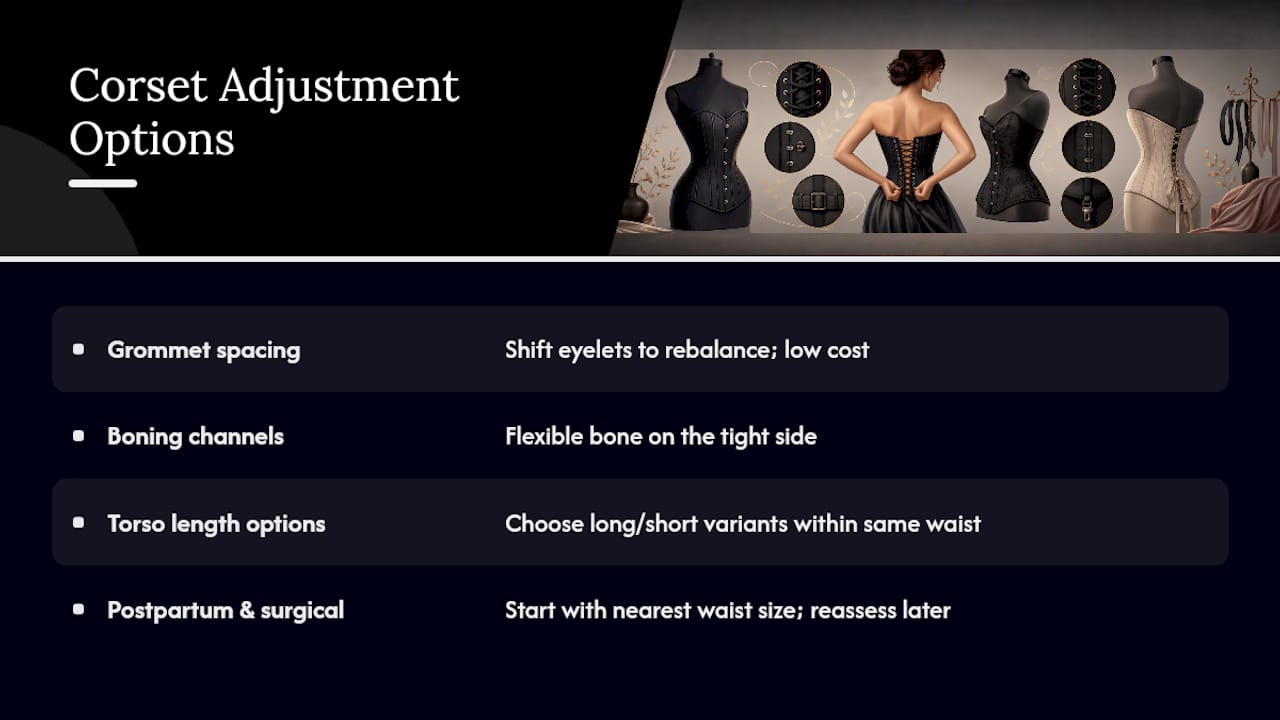
Grommet spacing offers the first fix. Many corsets lace symmetrically, but a skilled tailor or corsetiere can shift eyelet placement slightly to accommodate one side pulling tighter than the other. This costs far less than a full custom pattern and solves mild to moderate asymmetry effectively.
Boning channels are the second option. If your ribcage or hip curve doesn’t match the corset’s built-in spring, a tailor can sometimes swap out a rigid steel bone for a slightly more flexible one on the side that needs extra give. This won’t fix major structural differences, but it smooths out the small inconsistencies that cause pinching or gapping on one side only.
For torso length extremes, either very short or very long, look at brands offering multiple length options within the same waist size before assuming you need a full custom order. Some standard sizing charts include a “long” or “short” torso variant that solves the problem without the extra cost.
Postpartum bodies and post-surgical bodies often need a hybrid approach: start with a standard size closest to your current natural waist, then reassess after wearing it a few times, since these bodies frequently continue shifting for months. Rushing to lock in a size too early usually means buying twice.
How Should You Measure for Underbust vs. Overbust Styles?
The style you’re buying changes which measurements matter most. Underbust corsets sit below the bust and rely heavily on accurate rib spring and waist measurements, since there’s no cup structure to account for. Get your underbust measurement snug but not compressed, directly along the bra line, and pair it with your natural waist for sizing.
Overbust corsets add bust measurement and cup allowance into the equation. A size that fits your waist and rib spring perfectly can still gap or overflow at the bust if you skip this step. Measure at the fullest point of your bust with the tape level all the way around, not angled up or down, and check whether the brand offers cup sizing or a single standardized cup for all sizes.
Longline corsets, whether underbust or overbust, add torso length into the mix as a make-or-break measurement. A longline that’s too short for your torso will ride up and dig in at the bottom edge; too long, and it’ll fold or bunch at your natural waist. Measure your seated torso length carefully here, since this style has the least room for error.
If you’re choosing between styles and unsure which suits your goals, an underbust corset generally offers more styling flexibility since it layers under clothing, while overbust styles work as standalone statement pieces. Either way, the core measurements stay the same; only the emphasis shifts.
Getting Fit Right Comes Down to Patience, Not Guesswork
Precise measuring is the single biggest factor separating a corset that transforms your silhouette from one that sits in a drawer. Room24 builds sizing resources around real body variation, not a one-size assumption, because rib spring and torso length differ dramatically even among women sharing the same waist number. If your numbers fall between sizes or your torso doesn’t match a standard chart, reach out through Room24’s size guide before ordering.
Ready to Shop Your Size?
Room24 designs its corsets and bodywear around real fit variation, not a single standardized body, using sustainable materials that hold their shape wear after wear. Once you’ve got your natural waist and reduction number figured out, the next step is simple: check your measurements against Room24’s size guide, then browse the tops and corsets collection to find a style that matches your silhouette goals. If your numbers fall between sizes, Room24’s team can help you decide which way to round before you order.
Frequently Asked Questions
How tight should a corset be when I first wear it? A new corset should close fully but feel snug, not painful. Expect a slight breaking-in period over the first few wears before it molds to your shape.
What’s the difference between corset size and my actual waist size? Corset size reflects the garment’s internal waist measurement, which sits smaller than your natural waist by design. That gap is the intentional negative ease that creates shaping.
Can I use the same corset size chart for underbust and overbust styles? No. Overbust styles add bust and cup measurements into the equation, while underbust styles rely more heavily on rib spring and waist accuracy alone.
How do I know if I need a custom corset instead of off-the-rack? Consider custom if you have noticeable body asymmetry, an unusual torso length, or recent major weight change. Custom shops typically ask for 14 to 22 measurements versus the five basics for standard sizing.
Why does my torso length measurement seem too short? Readings under about 8 inches usually point to a measuring error from poor posture. Sit upright on a firm chair and remeasure from under one breast to your thigh crease.


