


For dramatic waist shaping, a sustainably made steel-boned corset is the strongest choice. For daily smoothing, a targeted sculpting bodysuit from Room24 delivers better all-day comfort without the commitment of lacing and boning.
- Choose a corset when you want a defined hourglass silhouette for a special occasion, a night out, or deliberate waist molding. The tradeoff is a firmer feel and a short break-in period before the garment molds to your body.
- Choose a sculpting bodysuit when you want smooth, comfortable shaping you can wear to the office, on a flight, or under everyday clothes. Modern sustainable bodysuits use zoned compression rather than uniform tightness, which means real comfort across a full day.
Room24 carries both categories, from structured corsets to sculpting bodysuits and swimwear designed with the same cinching intention.
Pro Tip: Before you add anything to your cart, spend 30 seconds on the product page looking for an OEKO-TEX Standard 100 logo or a named mill or factory. If neither appears, the sustainability claim is marketing, not evidence.
Table of Contents
- Which type of waist cincher is right for your goal?
- How to measure yourself for corsets and bodysuits
- What materials and sustainability signals actually matter
- Construction details that determine shaping and durability
- How to wear and style waist-cinching pieces
- Care, maintenance, and safe wearing practices
- What should you expect to pay for sustainable waist-cinching garments?
- Room24 corsets and bodysuits for every shaping goal
- Key Takeaways
- Why the “best” waist trimmer is always a construction question
- Shop Room24’s sculpting collection
- Useful sources
Which type of waist cincher is right for your goal?
The four main categories of waist-cinching fashion each solve a different problem. Knowing which one fits your lifestyle saves you a return.
Corsets are structured garments built from non-stretch fabric, steel boning, and a laced back. They create the most dramatic silhouette reduction and are the right pick for events, editorial styling, or anyone who wants intentional, adjustable shaping. Corsets use rigid construction to mold the torso, not elastic compression, which is why the effect is more pronounced and the fit more precise.
Waist cinchers (often underbust styles) sit between a corset and a bodysuit. They offer moderate compression with a shorter silhouette, making them a practical layer under high-waisted trousers or skirts when you want definition without a full corset.
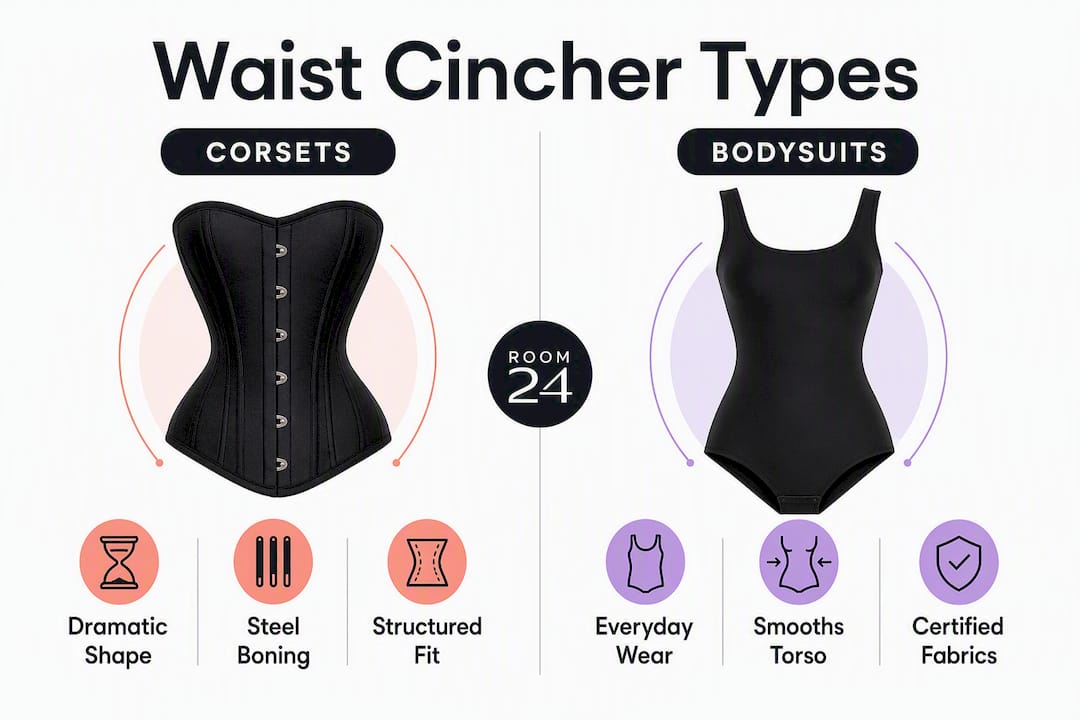
Sculpting bodysuits are the everyday workhorse. They smooth the torso from bust to hip, work under almost anything, and the best sustainable versions use zoned compression panels that hold their shape through a full workday. No lacing, no boning channels to manage.
Structured tops and corset-style tops give you the aesthetic of a corset with less compression. They are the most wearable option for office or daytime looks and layer cleanly under a blazer.
| Category | Shaping effect | Comfort and wear time | Sustainability signals to look for |
|---|---|---|---|
| Steel-boned corset | Dramatic, adjustable | Moderate; requires break-in | Recycled steel boning, deadstock fabric, OEKO-TEX |
| Waist cincher | Moderate | High; wear most of the day | OEKO-TEX, plant-based elastics |
| Sculpting bodysuit | Smooth, zoned | High; all-day comfortable | OEKO-TEX, recycled fibers, transparent sourcing |
| Structured top | Light to moderate | Very high; no compression | GOTS or OEKO-TEX certified fabric |
One thing worth stating plainly: none of these garments cause fat loss. Compressive garments reshape and redistribute tissue while worn; the effect is visual and temporary unless you commit to a long-term tight-lacing practice with a proper corset.
How to measure yourself for corsets and bodysuits
Getting the size wrong is the single most common reason shoppers return waist-cinching garments. Measure before you browse, not after.
- Underbust: Wrap a soft tape measure directly under your bust, snug but not tight. This is the primary measurement for corsets.
- Natural waist: Find the narrowest point of your torso, usually an inch or two above your navel. Exhale naturally and measure without sucking in.
- High hip: Measure about 3–4 inches below your natural waist, across the widest part of your hip bones (not the fullest part of the seat).
- Torso length: Measure from the base of your neck to your natural waist. For bodysuits, this determines whether a garment will sit correctly or ride up.
- Compare to the brand’s flat garment measurements, not just the labeled size. Natural and deadstock fibers have no stretch, so a labeled “S” in a sustainable corset may fit differently than a labeled “S” in a stretch bodysuit.
When sizing for a corset, size for your underbust and natural waist, then check that the hip measurement falls within the garment’s range. For bodysuits, torso length matters as much as waist measurement because a bodysuit that is too short will pull and gap at the crotch.
- Size for shaping when you want the garment to do work: go to your exact measurement or one size down if the brand’s chart allows.
- Size for comfort when you plan to wear the piece all day: match your measurement exactly and allow 1–2 inches of ease.
Pro Tip: If a corset’s flat waist measurement is within half an inch of your own, that is a strong fit signal. For deadstock or natural-fiber corsets, trust the flat measurement over the labeled size every time.
What materials and sustainability signals actually matter
Genuine eco-friendly sculpting garments disclose material sourcing and manufacturing details, and ideally carry a verifiable certification. Vague terms like “green” or “natural” on their own mean nothing.
The signals worth checking:
- OEKO-TEX Standard 100: Tests for hazardous substances in every component, including thread and dyes. The certificate number on the product page is verifiable at the OEKO-TEX website.
- GOTS (Global Organic Textile Standard): Tracks organic fiber from field to finished garment, covering social and environmental criteria throughout the supply chain.
- Recycled fibers and plant-based elastics: Reduce virgin resource use; look for a specific percentage (e.g., “78% recycled nylon”) rather than a vague “eco-friendly fabric” claim.
- Deadstock fabric: Sourced from surplus luxury mill runs, which reduces waste but means limited quantities and sometimes variable dye lots.
- Country-of-origin and named factory or mill: The strongest on-page trust signal. Product pages that list audited factory programs or certificate numbers give you something to verify; a page with no sourcing detail gives you nothing.
Pro Tip: Search the OEKO-TEX public database with the certificate number from the product page. If it does not appear, the certification claim is unverified.
Construction details that determine shaping and durability
The difference between a corset that lasts three years and one that warps after six months comes down to a handful of construction choices.
- Steel boning vs. spiral steel vs. plastic: Flat steel bones hold their shape under tension and resist bending. Spiral steel allows more torso movement and suits shorter corsets. Plastic boning is a cost-cutting choice that warps with heat and body pressure.
- Busk and lacing: A solid steel busk (the front closure) and a laced back give you precise, adjustable tension. Hook-and-eye closures are faster but offer less adjustment range.
- Panel count: More panels mean a more contoured fit. A six-panel corset shapes less precisely than a twelve-panel construction.
- Seam reinforcement and lining: Double-stitched seams and a separate lining layer prevent the outer fabric from bearing compression stress alone, which extends garment life significantly.
- Recycled steel boning and coated finishes: Ethical makers source recycled steel for boning and apply anti-corrosion coatings, which matters for longevity when the garment is hand-washed regularly.
Look for boning channels visible in product photos, a close-up of the busk, and a description that names the boning type. A product page that says “boned” without specifying the material is telling you something.
How to wear and style waist-cinching pieces
A corset or sculpting bodysuit earns its price when you wear it more than once. Here is how to get the mileage.
- Daytime: Layer a structured corset over a fitted white tee or under an oversized blazer. The corset becomes the focal point; the blazer softens it for an office or brunch setting.
- Evening: Wear a corset over a silk slip dress or pair a sculpting bodysuit with wide-leg trousers and a statement heel. The bodysuit keeps everything smooth without adding bulk under fitted fabric.
- Resort and swim: Room24’s sculpting one-pieces work as both swimwear and resort cover-ups. Check the one-piece swimsuit styling guide for body-proportion tips that apply directly to sculpting suits.
- Underwear: Wear seamless, low-rise underwear under a bodysuit. Under a corset, a thin cotton liner protects the lining and your skin.
Pro Tip: A steel-boned corset transitions across seasons when you treat it as a top, not an undergarment. Wear it over a turtleneck in winter, over nothing in summer. Cost-per-wear drops fast when the piece works twelve months a year.
Care, maintenance, and safe wearing practices
Steel-boned and natural-fiber garments need specific care or they degrade quickly.
- Hand wash in cold water with a gentle detergent. Machine washing stresses boning channels and warps steel bones.
- Air dry flat or on a hanger, never in a dryer. Heat distorts boning and shrinks natural fibers.
- Store flat or hanging, not folded. Folding a boned garment creases the bones permanently.
- Break in a new corset gradually: Wear it for one to two hours on day one, adding 30 minutes per session over two to three weeks. Steel-boned garments mold to your ribcage over multiple wears and should not be returned after one uncomfortable session.
- Check after each wear for any redness, numbness, or difficulty breathing. These are signals the garment is too tight or incorrectly positioned.
Remove any compressive garment immediately if you experience numbness, tingling, or shortness of breath. A well-fitted corset should feel firm, not painful.
Proper care is also a sustainability practice. A corset that lasts five years instead of one uses a fraction of the resources.
What should you expect to pay for sustainable waist-cinching garments?
| Price band | Typical features |
|---|---|
| Entry-level sustainable shapewear — | Recycled fibers, basic OEKO-TEX claim, no boning, limited sizing |
| Mid-range corsets and bodysuits — | Steel or spiral boning, OEKO-TEX or GOTS certification, multi-panel construction, clear sourcing |
| High-end and deadstock corsets — | Hand-finishing, recycled steel boning, deadstock luxury fabric, small-batch production, full supply-chain transparency |
What justifies the higher price:
- Certified materials with verifiable certificate numbers
- Recycled steel boning with anti-corrosion coating
- Hand-bound edges and reinforced seam finishing
- Named factory or mill with audit documentation
- Small-batch or deadstock sourcing that limits production waste
Many shoppers now prioritize comfort over style when buying shaping garments, which means the mid-to-high-end market has responded with better breathability and construction, not just better marketing. A $180 sculpting bodysuit made from certified recycled fibers with zoned compression panels will outlast and outperform three $60 alternatives, and the math on cost-per-wear favors the investment.
Room24 corsets and bodysuits for every shaping goal
Room24 designs waist-cinching pieces with the same priorities this guide covers: sustainable materials, precise construction, and a silhouette that works for real life.
- For dramatic shaping: The Kelly Corset and Selma Corset are structured statement pieces built for occasions where the silhouette is the point. Check the product pages for boning details and flat measurements before ordering.
- For everyday smoothing: Room24’s sculpting bodysuits use targeted construction to smooth without restricting. The Milan Geometric Mesh Cutout Bodysuit is a strong example of how material and cut work together.
- For resort and swim sculpting: The swimwear collection includes one-piece options designed to sculpt at the waist while functioning as actual swimwear.
Before buying, confirm the flat garment measurements match your own, look for certification badges on the product page, and check the returns policy in case the fit needs adjustment after break-in.
Pro Tip: Contact Room24’s customer service with your measurements before ordering a corset. Getting the underbust and waist measurements confirmed against the garment’s flat pattern takes two minutes and eliminates the most common sizing mistake.
Key Takeaways
A steel-boned corset delivers the most dramatic waist shaping, but a certified sculpting bodysuit from Room24 is the smarter daily choice for women who want sustainable, comfortable cinching they can actually wear.
| Point | Details |
|---|---|
| Match garment to goal | Corsets for dramatic shaping; sculpting bodysuits for all-day smoothing and everyday wear. |
| Measure before you buy | Take underbust, natural waist, high hip, and torso length; compare to flat garment measurements, not labeled sizes. |
| Verify sustainability claims | Look for OEKO-TEX Standard 100 certificate numbers or named factory details on the product page. |
| Care extends garment life | Hand wash cold, air dry flat, and break in corsets gradually over two to three weeks. |
| Room24 for both categories | Room24 carries corsets, sculpting bodysuits, and swimwear with transparent construction details across all price points. |
Why the “best” waist trimmer is always a construction question
The conventional wisdom says to pick a waist-cinching garment based on how it looks on a model. That is the wrong starting point. The garment’s construction determines whether it will actually fit, last, and perform the way you expect.
A sculpting bodysuit with vague “eco-friendly” fabric and no certification is not a sustainable choice, regardless of how the brand positions it. A corset with plastic boning will warp within months of regular wear. The shoppers who get the most from these garments are the ones who read the product page like a contract: boning type, panel count, certification number, flat measurements. Those details tell you more than any lifestyle photo.
Room24’s approach, designing pieces with signature cut-outs and sculpting fits built on transparent material choices, reflects what this category should look like at the mid-to-high end. The pieces are meant to be worn, not just purchased.
Shop Room24’s sculpting collection
Room24 makes the decision straightforward. The corsets and structured tops are built for statement shaping, and the sculpting bodysuits are designed for women who want cinching they can wear every day without thinking about it.
Before you check out, run through this list:
- Confirm your flat underbust and waist measurements match the garment’s listed dimensions.
- Look for a certification badge (OEKO-TEX or equivalent) on the product page.
- Check that the returns policy covers fit adjustments, especially for corsets in their break-in period.
- Confirm shipping to your region is available at checkout.
Browse the full collection at room24.co.uk and use the size guide on each product page before placing your order.
Useful sources
- What to Know About Body-Enhancing Products in Sustainable Fashion — supports materials, certification guidance, and the comfort-over-style data point.
- Waist Trainer vs Corset: Which is Truly Better for You? — explains the construction difference between corsets and elastic-based cinchers, and addresses the fat-loss myth.
- Why Sustainable Corsets Cost More — covers deadstock sourcing, recycled steel boning, break-in expectations, and sizing for natural fibers.
- The New Era of Comfort: Why Your Next Women’s Shapewear Bodysuit Should Be Sustainable — explains zoned compression in modern sustainable bodysuits.
- Sculpting Bodysuit product page example with OEKO-TEX signals — illustrates what strong on-page certification and factory transparency looks like in practice.


