


Women: EU 38 ≈ UK 10. Men: EU 50 ≈ UK/US 40 chest. Shoes: EU 38 ≈ UK 5 for women, EU 43 ≈ UK 9 for men. UK women’s clothing sizes generally run about two sizes lower than EU sizes (UK 10 = EU 38), while UK shoe sizes sit roughly 32 points below the EU scale.
Those offsets hold as a starting point, not a guarantee. EU sizing splits into German, French, and Italian variants that don’t always align, and shoe sizes follow a completely different logic based on foot length in centimeters. Before you buy, measure your foot length in cm and check the brand’s own size chart. This guide gives you the full breakdown so one bad online order doesn’t turn into a returns headache.
- Women’s clothing: EU 36 ≈ UK 8, EU 38 ≈ UK 10, EU 40 ≈ UK 12
- Men’s clothing: EU 48 ≈ UK/US 38, EU 50 ≈ UK/US 40
- Women’s shoes: EU 37 ≈ UK 4, EU 38 ≈ UK 5, EU 39 ≈ UK 6
- Men’s shoes: EU 42 ≈ UK 8, EU 43 ≈ UK 9, EU 44 ≈ UK 10
Key Takeaways
Accurate EU to UK size conversion depends on matching your own body measurements in centimeters to a brand’s specific chart, not on memorizing a fixed numeric offset.
| Point | Details |
|---|---|
| Women’s baseline offset | EU 38 typically equals UK 10, but confirm with bust and hip cm measurements first. |
| Shoes need cm, not offsets | Foot length in centimeters is more reliable than subtracting a fixed number from EU shoe sizes. |
| Brands vary within “EU” | German, French, and Italian sizing standards differ, so always check which system a brand uses. |
| Sculpting pieces size differently | Stretch swimwear and bodywear should be sized to your largest measurement, not an average. |
| Measure once, reuse often | Keep your chest, waist, hip, and foot measurements saved to speed up every future online order. |
Table of Contents
- Women’s Clothing: EU to UK Sizes by Body Measurement
- Men’s Clothing: EU to UK Sizes by Chest Measurement
- Children’s Sizes: EU to UK by Age and Height
- Shoe Conversions: EU to UK for Women, Men, and Unisex Styles
- How to Measure Chest, Waist, Hips, and Foot Length
- Fit Notes and Brand Variation: Common Pitfalls
- Room24 Sizing: How We Size Swimwear and Bodywear
- Why Do EU and UK Sizes Differ in the First Place?
- Do Virtual Sizing Tools Actually Help?
- Editorial Take: What Actually Matters When Converting Sizes
- Frequently Asked Questions
- Sources
Women’s Clothing: EU to UK Sizes by Body Measurement
Numbers alone won’t save you from a badly fitting dress. What matters is matching your actual bust, waist, and hip measurements to the chart, because EU 38 consistently lines up with UK 10 in women’s sizing across most European brands.
Body measurements matter more than the label size once you factor in fit type. For dresses, your bust measurement usually decides the size; for trousers or skirts, go by waist and hip. Tops fall somewhere in between, so measure both bust and waist and pick whichever pushes you into the larger size.
Pro Tip: For swimwear and other body-hugging pieces, size according to your largest measurement rather than an average, since stretch fabric forgives a snug fit but never a too-small one.

Men’s Clothing: EU to UK Sizes by Chest Measurement
Men’s sizing sounds simpler until you hit outerwear, where EU numbering and UK/US inch sizing part ways completely.
UK and US jacket sizes typically match in inches, while EU sizing uses an entirely different number scale, so a UK 40 jacket becomes an EU 50, not an EU 40.
- Shirt collar sizes are usually given in inches in the UK and centimeters in EU charts. Convert by multiplying inches by 2.—.
- Use chest measurement for jackets and coats, but neck measurement for dress shirts.
- If a product page only lists an EU size, check for a cm measurement before ordering. Translating inches to centimeters avoids the most common men’s sizing mistake.
Children’s Sizes: EU to UK by Age and Height
Kids’ clothing sizing leans on age ranges, but a child’s actual height tells you far more than their birth certificate does.
| Age Range | UK Size | EU Size | Height (cm) |
|---|---|---|---|
| 1–2 years | 1–2Y | 86–92 | 86–92 |
| 3–4 years | 3–4Y | 98–104 | 98–104 |
| 5–6 years | 5–6Y | 110–116 | 110–116 |
| 7–8 years | 7–8Y | 122–128 | 122–128 |
| 9–10 years | 9–10Y | 134–140 | 134–140 |
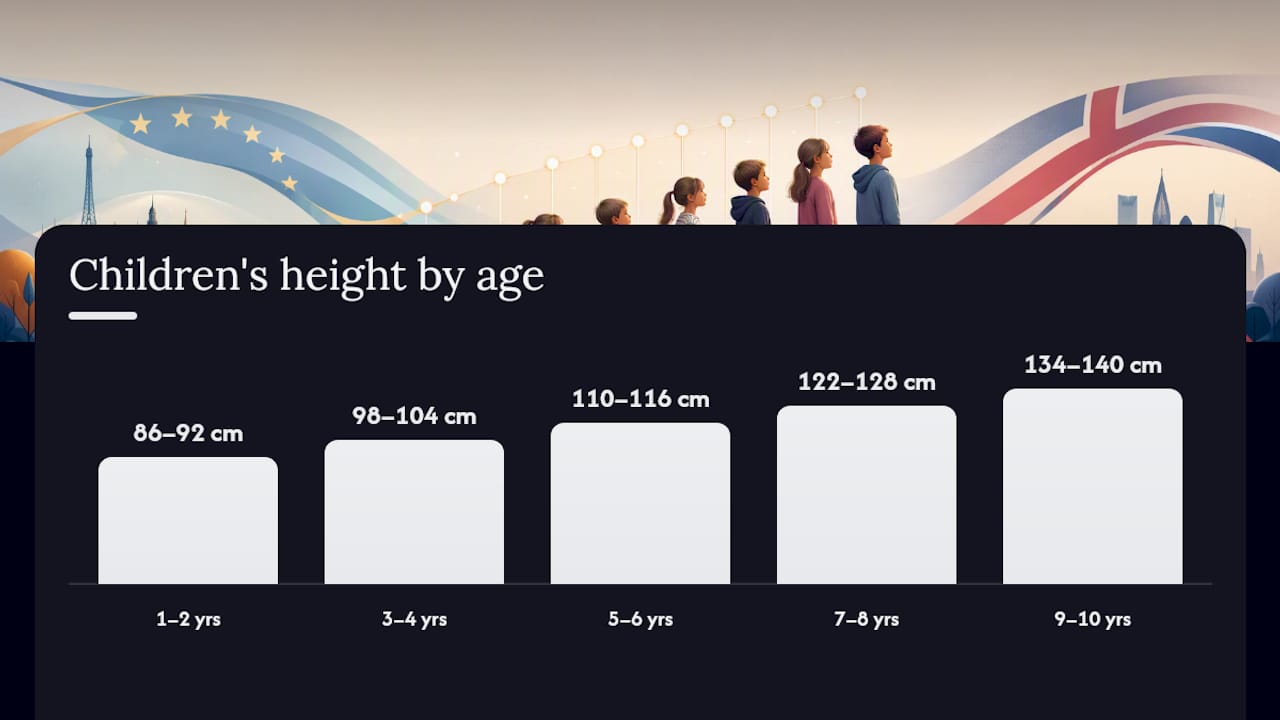
Measure height standing barefoot against a wall, and measure chest for tops if the child sits between two age bands. Children’s conversion charts generally use height in centimeters as the anchor figure, not age alone.
Pro Tip: Buy one size up for fast-growing children between ages 4 and 10, especially in coats and trousers meant to last a full season.
Shoe Conversions: EU to UK for Women, Men, and Unisex Styles
Shoe sizing is where most EU to UK conversion mistakes happen, because the two systems aren’t built on the same logic at all.
The EU scale increases by roughly 6.66 to 6.67 millimeters per whole size, unlike the UK system’s own step pattern. That’s why a flat numeric offset (subtract 32) works most of the time but breaks down at half sizes or with certain brands.
- Stand on a piece of paper, barefoot, with your heel against a wall.
- Mark the tip of your longest toe and measure the distance in centimeters.
- Measure both feet, since most people have one foot slightly larger than the other, and size to the bigger one.
- Match that cm figure to the chart rather than guessing from your usual UK size.
Pro Tip: Trainers and everyday flats can be sized to your exact cm measurement, but formal shoes and boots often need a half size up to allow for thicker socks or slight foot swelling later in the day.
How to Measure Chest, Waist, Hips, and Foot Length
Get these four measurements right and most EU to UK sizing guesswork disappears.
- Chest/bust: Wrap the tape around the fullest part of your chest, keeping it level and snug but not tight.
- Waist: Measure around your natural waistline, usually just above your belly button, without pulling the tape taut.
- Hips: Measure around the widest part of your hips and bottom, feet together.
- Foot length: Measure from heel to the longest toe while standing, in centimeters, at the end of the day when feet are slightly larger.
- Measure over light clothing or none at all, never over bulky layers.
- Repeat each measurement twice for accuracy and use the larger number.
- Convert cm to inches by dividing by 2.—, or inches to cm by multiplying by 2.—.
- As a rough mental shortcut, 1 inch equals about 2.5 cm, which is close enough for quick checks while browsing.
Fit Notes and Brand Variation: Common Pitfalls
Two EU 38s from two different brands can fit like completely different sizes, and it’s rarely your fault.
- Vanity sizing means some brands label garments smaller than their actual measurements to flatter customers.
- Regional EU variants exist because German, French, and Italian sizing standards aren’t identical, even though they all get labeled “EU.”
- Measurement method differences between brands mean one company’s “waist” measurement point isn’t always another’s.
Before you check out, run through this: does the product page list cm measurements, not just a size label? Does the brand mention which EU system it uses? Are there customer reviews mentioning fit? If any answer is no, size using your own cm measurements against whatever chart is available, and lean toward the brand’s own size guide over a generic converter.
Plus-size, petite, maternity, and formalwear often use separate sizing standards entirely, so treat those categories as their own conversion exercise rather than assuming the same EU to UK offset applies.
Room24 Sizing: How We Size Swimwear and Bodywear
Room24 sizes swimwear and bodywear around body measurements first, size labels second. Because sculpting pieces use engineered stretch and structured panels, a size that feels snug in the fitting room settles into the intended shape within a few wears. We prioritize bust and hip measurement over the vague “usual size” most shoppers default to online.
Choosing between two sizes comes down to intent: pick the smaller size for a sculpting, second skin fit, or the larger size for a relaxed, all-day comfort fit, particularly in bodysuits worn under tailoring.
Pro Tip: If your measurements fall between two sizes on our chart, size up for swimwear you’ll wear actively and down for pieces meant to sculpt under going-out clothing.
Full body measurement breakdowns and category-specific notes live on the Room24 size guide, alongside guidance in our swimsuit sizing article.
Why Do EU and UK Sizes Differ in the First Place?
The gap between EU and UK sizing isn’t an accident of history. It comes down to two different measurement philosophies developed decades apart, for different manufacturing markets.
UK sizing evolved from British tailoring standards, originally tied more closely to imperial measurements (inches) and a smaller numeric range. EU sizing, by contrast, was built as a continental standard meant to unify manufacturing across Germany, France, Italy, and other countries that each had their own local systems before harmonization efforts began. That unification was never fully complete, which is exactly why three separate regional standards still coexist under the EU label today.
Shoe sizing tells a similar story but with metric logic baked in from the start. The continental EU scale is based directly on foot length, with each size step representing a fixed jump of about two thirds of a centimeter. UK and US shoe sizing developed from separate historical measuring systems using different base units entirely, which is why converting between them isn’t a clean formula, just a close approximation.
Once you understand that EU numbers were never designed to map neatly onto UK numbers, the whole conversion exercise makes more sense. You’re not translating one language into another with a fixed dictionary. You’re comparing two systems that solve the same problem (fitting a body) with different starting assumptions.
Do Virtual Sizing Tools Actually Help?
Virtual fit tools have gotten genuinely useful for reducing sizing guesswork, though none replace a tape measure entirely.
Many UK and European retailers now embed size-prediction widgets directly on product pages that ask for your height, weight, and usual size in another brand, then suggest a size for that specific item. These tools work best for basics and structured garments where fit is predictable, and less well for stretch fabrics or asymmetric cuts where body shape matters more than a single algorithm can account for.
Standalone sizing apps that scan your body measurements through your phone camera exist too, though accuracy varies depending on lighting and how you stand. For most shoppers, the combination of a physical tape measure and a brand’s published cm chart still outperforms any app, simply because it removes guesswork about camera calibration or clothing worn during the scan.
The most reliable approach stays low-tech: take your own measurements once, save them in your phone, and compare them against each retailer’s own chart before you buy. Retailer-specific guides, including detailed ASOS and Footlocker size charts, remain more accurate for their own stock than any generic conversion widget, because they’re built from that brand’s actual pattern data.
Editorial Take: What Actually Matters When Converting Sizes
Most sizing guides treat EU to UK conversion like a math problem with one correct answer. It isn’t. The research here points to a more useful truth: a size label is a starting guess, and your own cm measurements are the only real authority in the room.
The conventional advice, “just subtract 28 from your EU number”, works often enough to feel trustworthy, which is exactly the problem. It fails quietly on stretch fabrics, half shoe sizes, and anything from a French or Italian brand using its own numbering logic. Shoppers who rely on that shortcut alone are the ones filling out return forms.
What deserves more attention than it gets: foot length in centimeters for shoes, and bust/hip measurement for anything with structure or stretch. Those two numbers solve more sizing problems than any chart memorization ever will. If you take one thing from this guide, measure yourself once, properly, and keep that number on hand every time you shop.
Frequently Asked Questions
Is EU 38 the same as UK 10 in every brand? Usually, yes, for women’s clothing. But French and Italian labeled “EU 38” garments can run slightly differently, so check the brand’s cm measurements when possible.
How do I convert EU shoe sizes to UK sizes? Measure your foot length in centimeters and match it to a chart rather than subtracting a fixed number, since the EU scale steps up by about 6.67mm per size while the UK scale doesn’t follow the same increment.
Do half sizes exist in both EU and UK shoe systems? Yes, though they don’t always align. An EU half size sometimes falls between two UK whole sizes, which is another reason cm measurement beats numeric conversion for footwear.
Are unisex sizes converted the same way as gendered sizes? Not always. Unisex shoe charts often use one scale (frequently the men’s scale), so women should check whether a “unisex” size assumes a men’s foot-length baseline before converting.
What should I do if my measurements fall between two EU sizes? Size up for stretch fabric and structured pieces like swimwear or bodysuits, and check customer reviews for fit feedback on rigid fabrics like denim or tailoring.
Sources
- Calks
- Shoe size
- International Clothing Size Converter 2024-2025 | UK US EU Asian Size Chart Calculator | Smart Unit Convert


