


Mindful production means garments are made on purpose: small batches, traceable supply chains, and design built for longevity rather than speed. That approach delivers higher-quality pieces with a lower environmental and social cost over their lifetime. If you’re deciding whether a price premium is worth it, three things tell the story fast:
- Product quality and durability. Intentional construction and material selection produce garments that hold their shape, fit, and finish across seasons.
- Lower lifecycle environmental cost. Fewer runs, less waste, and circular-economy design mean each piece carries a smaller cumulative footprint.
- Worker wellbeing and transparency. Mindful production practices tie directly to factory conditions, fair oversight, and supply-chain visibility.
Room24 is built on exactly this premise: pieces that are sustainably sexy, not just aesthetically sharp.
Table of Contents
- What mindful production actually looks like in fashion
- How mindful production improves quality, waste, and worker wellbeing
- Why this should matter to you as a high-end fashion shopper
- How to shop for mindful production: a practical checklist
- Price and lifecycle trade-offs: what you’re actually paying for
- How Room24 demonstrates mindful production in practice
- How mindful production evolved in the fashion industry
- Mindful production vs. conventional and fast fashion
- Challenges of implementing mindful production in the U.S. fashion sector
- What shoppers report when they make the shift
- Key Takeaways
- Style with a conscience: why this matters beyond the label
- Room24’s mindful-made collections are worth your attention
- Useful sources
What mindful production actually looks like in fashion
The phrase gets used loosely, so here’s what it means in practice. Mindful making prioritizes small-batch runs, human-led quality oversight, and design for longevity over volume and speed. Material intentionality is central: choosing fibers that can be recycled or repaired, avoiding complex blends that end up in landfill because no recycler can separate them.
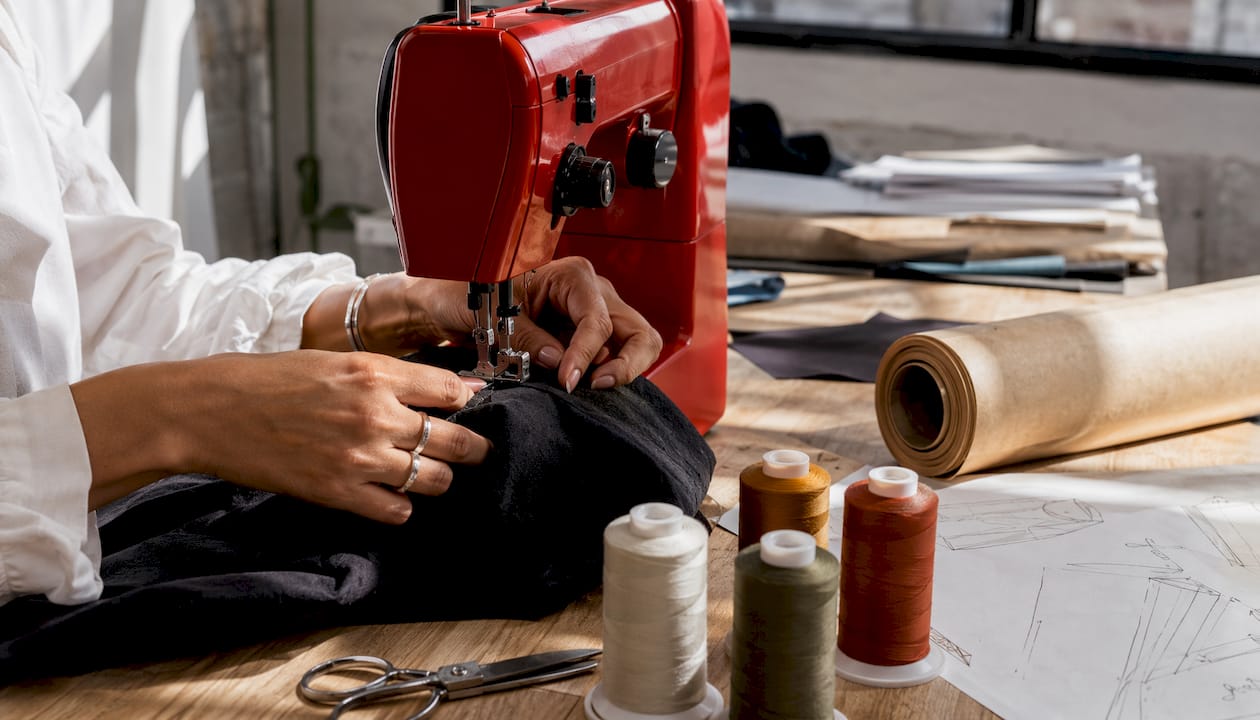
Contrast that with high-throughput mass production, which optimizes for speed-to-market. Blended synthetic fabrics are cheap to produce but nearly impossible to recycle. Overproduction is baked into the model. Mindful production rejects that logic, treating every offcut as a potential resource rather than a disposal problem.
Pro Tip: The single most meaningful label to look for isn’t a broad certification like “eco-friendly” — it’s supply-chain traceability: a brand that names its factories and materials by tier.
How mindful production improves quality, waste, and worker wellbeing
Mindfulness-based practices reduce procrastination and stress among production personnel, which translates to sharper focus and fewer defects on the line. That’s not abstract: attentive workers catch errors earlier, and earlier catches mean less scrap.
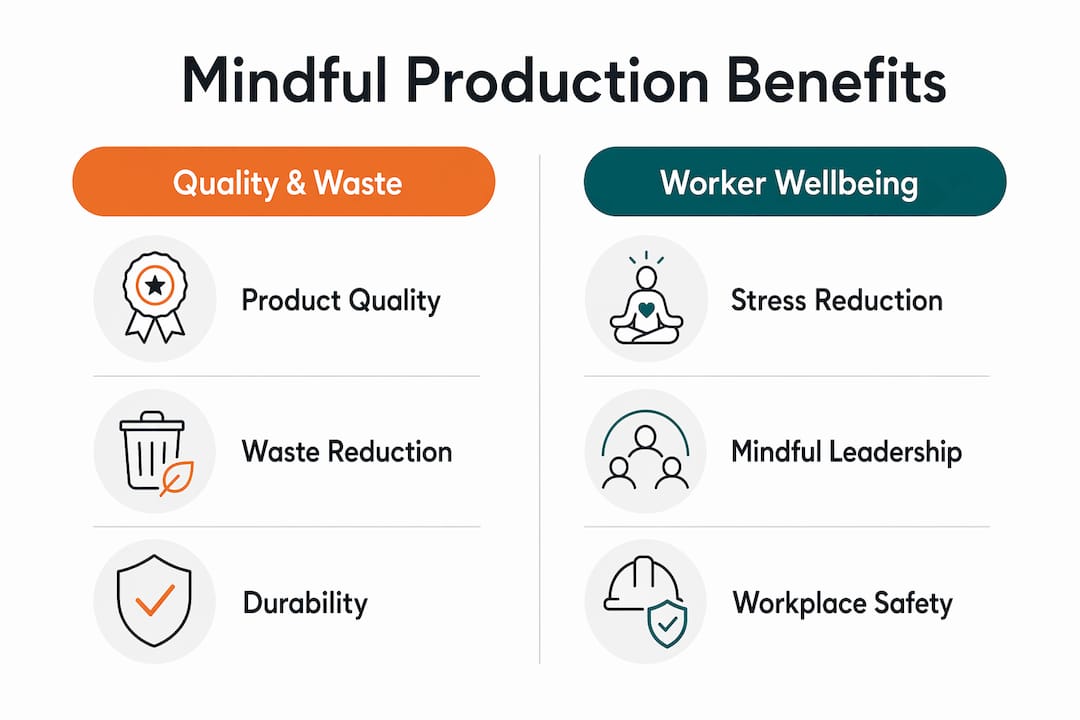
At the manufacturing level, mindful manufacturing habits like 5S workplace organization and lean waste-elimination training reduce material loss and extend equipment life. Immediate leak detection saves water; employee incentive programs cut scrap rates. The cumulative effect is a cleaner, more efficient operation.
Mindful leadership amplifies this further. A study of manufacturing workers found that mindful leadership is positively linked to employee green creativity, mediated by moral reflectiveness and environmental passion. Workers who feel their leaders genuinely care about sustainability don’t just comply — they innovate.
| Benefit category | What it looks like in practice |
|---|---|
| Product quality | Human oversight catches defects earlier; fewer returns and replacements |
| Waste reduction | 5S organization and lean training cut scrap and material loss |
| Workforce wellbeing | Mindful leadership builds environmental passion and reduces stress |
| Environmental output | Leak detection, energy monitoring, and small-batch runs lower resource use |
Why this should matter to you as a high-end fashion shopper
Better construction changes the ownership experience in ways that compound over time. A garment designed for repair, made from a single-fiber fabric, and cut with longevity in mind holds its shape longer, resists pilling, and can actually be fixed when something goes wrong. That’s not a minor convenience — it’s the difference between a piece you wear for three years and one you replace after six months.
Mindful production also reduces the noise of overchoice. Philip Kotler has written about how markets become flooded with minor iterations that consume resources without adding real value. Brands that practice mindful production resist that pressure, which means their collections are smaller, more considered, and easier to shop with confidence.
The practical payoff: garments made with intentional construction and quality materials need replacing less often, which lowers your cumulative spending and environmental impact simultaneously.
How to shop for mindful production: a practical checklist
Use these signals when you’re on a product page or talking to a brand’s customer service team.
- Look for small-batch language. Phrases like “limited run,” “made to order,” or specific production quantities signal intentional volume control.
- Check material traceability. The brand should name the fiber source, not just say “sustainable materials.” GOTS-certified organic cotton or Oeko-Tex Standard 100 fabrics are traceable by definition.
- Look for single-fiber or easily separable construction. Garments made from one fiber type (100% cotton, 100% recycled nylon) can actually be recycled. Mixed-fiber pieces usually can’t.
- Ask about repair or take-back programs. Brands serious about longevity offer repair guides, spare hardware, or end-of-life return options.
- Find supplier transparency. A brand that names its manufacturing partners, locations, and oversight practices is accountable in a way that vague “ethical sourcing” claims are not.
- Weigh certifications against brand-level transparency. A certification is a floor, not a ceiling. A brand that publishes its factory list and production volumes tells you more than a logo on a hang tag.
- Ask about lead times. Long lead times often indicate made-to-order or small-batch production. Instant availability of every size in every color is a fast-fashion signal.
Price and lifecycle trade-offs: what you’re actually paying for
Mindful-made garments cost more for specific, traceable reasons. Small-batch labor is more expensive per unit than mass production. Traceability systems, higher-grade materials, and repairability engineering all add cost. Reduced waste handling saves money at the back end, but those savings rarely fully offset the front-end investment.
The lifecycle math, though, shifts the calculation. A garment that lasts three to five seasons instead of one or two costs less per wear, generates less textile waste, and requires fewer replacement purchases.
| Factor | Mindful production | Conventional fast fashion |
|---|---|---|
| Batch size | Small, intentional runs | High-volume, speed-to-market |
| Material choice | Single-fiber, traceable, recyclable | Often blended, low-cost, hard to recycle |
| Useful life | Multiple seasons with proper care | One to two seasons typical |
| End-of-life options | Repair, recycle, take-back | Landfill or incineration |
| Cumulative cost per wear | Lower over time | Higher when replacement frequency is counted |
How Room24 demonstrates mindful production in practice
Room24’s design language is built around pieces that earn their place in a wardrobe rather than filling it temporarily. The bodysuit collection illustrates this: sculpting fits and signature cut-outs are design decisions that require precise construction and quality materials to execute. A poorly made bodysuit with cut-out detailing fails immediately — the fabric distorts, the seams pull. Room24’s approach demands the kind of human-led oversight that mindful production describes.
Key proof points:
- Material focus. Sustainable fabrics are central to the brand’s identity, not a marketing add-on.
- Design intentionality. Statement pieces like the swimwear collection are built for longevity of style and construction, not seasonal disposability.
- Transparency signals. The brand’s positioning as “sustainably sexy” is a public commitment to holding both values simultaneously.
How mindful production evolved in the fashion industry
The concept didn’t emerge from nowhere. The slow fashion movement gained traction in the early 2000s as a direct response to the acceleration of fast fashion cycles. Brands like Patagonia had been practicing versions of mindful production since the 1970s, but the language of “mindful making” as a defined framework developed alongside broader sustainability discourse in the 2010s.
The supply-chain mindfulness framework formalizes what practitioners had been doing intuitively: integrating presence, transparency, resilience, and continuous learning into production decisions. By the mid-2010s, circular-economy principles had entered mainstream fashion conversation, and design for disassembly moved from niche to expected in premium sustainable brands.
Mindful production vs. conventional and fast fashion
The core difference isn’t price point — it’s intention. Conventional production optimizes for efficiency and margin. Fast fashion optimizes for speed and volume. Mindful production optimizes for impact: on the wearer, the worker, and the environment.
Fast fashion’s model depends on planned obsolescence and trend cycling. Mindful production resists both. Where fast fashion treats overproduction as a cost of doing business, mindful production treats it as a failure of planning. The supply-chain transparency that mindful brands maintain makes hidden environmental and social harms visible and therefore addressable.
Challenges of implementing mindful production in the U.S. fashion sector
The U.S. domestic manufacturing base has contracted significantly since the 1990s. Rebuilding the skilled labor, supplier relationships, and infrastructure that mindful production requires takes time and capital that most brands don’t have. Small-batch production is also harder to finance: banks and investors are more comfortable with volume projections than with intentional scarcity.
Greenwashing complicates the picture further. When “sustainable” becomes a marketing term rather than a verifiable standard, shoppers lose the ability to distinguish genuine mindful production from performative claims. Certification fragmentation — dozens of competing labels with different standards — adds confusion rather than clarity.
What shoppers report when they make the shift
Shoppers who move from fast fashion to mindfully produced pieces consistently describe the same shift: fewer purchases, stronger attachment to individual garments, and less decision fatigue. The wardrobe gets smaller and more functional. Pieces that were bought with intention get worn more, cared for better, and kept longer.
The environmental logic follows naturally from that behavior change. Buying less, wearing more, and repairing rather than replacing are the highest-impact actions an individual shopper can take. Mindful production makes those actions easier by producing garments worth keeping.
Key Takeaways
Mindful production delivers higher-quality, longer-lasting garments with lower lifetime environmental cost — and for high-end shoppers, that’s the clearest justification for the price premium.
| Point | Details |
|---|---|
| Supply-chain visibility matters most | Look for brands that name factories and materials by tier, not just use “ethical” labels. |
| Design for longevity changes ownership | Single-fiber construction and repairability mean garments last multiple seasons, not one. |
| Price premium maps to lifecycle value | Higher upfront cost produces lower cost-per-wear when replacement frequency drops. |
| Mindful leadership drives real results | Research links mindful leadership to measurable green creativity and worker engagement in manufacturing. |
| Room24 applies this directly | Room24’s sculpting fits, sustainable fabrics, and design-first approach reflect mindful production in practice. |
Style with a conscience: why this matters beyond the label
The conversation around mindful production tends to get stuck on certifications and carbon math. That’s useful, but it misses something. The real argument for mindful production in high-end fashion isn’t environmental guilt — it’s that it produces better clothes. More considered design, more precise construction, materials chosen for how they perform rather than how cheaply they can be sourced. The sustainability case and the quality case are the same case.
What gets underestimated is how much the shopper’s experience changes when a brand has actually thought about the full lifecycle of a piece. You feel it in the fit, the weight of the fabric, the way a seam holds after a year of wear. That’s not marketing language. It’s the direct result of production decisions made with intention rather than speed.
Room24’s mindful-made collections are worth your attention
Room24 was built on the premise that sustainable and sexy aren’t opposites. Every piece in the collection — from sculpted bodysuits to statement swimwear — is designed with the kind of construction quality that mindful production demands. Sustainable fabrics, precise fits, and design built to last more than one season.
Browse the current collections at Room24 and find pieces made to be worn, not replaced.
Useful sources
- Strategic Serenity: Applying mindfulness principles to supply chain excellence — Academic framework linking mindfulness philosophy to supply-chain transparency, resilience, and continuous improvement.
- Exploring the Impact of Mindful Leadership on Employee Green Creativity — Two-wave manufacturing study showing how mindful leadership drives worker environmental passion and green creativity.
- Mindful making process — Sustainability Directory — Practical definition of small-batch, human-led, longevity-first production attributes.
- Mindful manufacturing habits — Sustainability Directory — Operational examples including 5S, lean training, and water-saving practices.
- Mindful production strategies — Sustainability Directory — Covers circular-economy applications including design for disassembly and lifecycle assessment in textiles.
- Mindfulness for time management — KnowYourBest — Evidence on how mindfulness-based practices reduce procrastination and improve focus in workplace settings.


