

TL;DR:
- Bluesign certification ensures textile inputs and manufacturing processes meet strict chemical and resource standards before a product is made.
- The bluepass mark verifies that at least 90% of a garment’s components are bluesign APPROVED and that factories meet compliance criteria.
Bluesign certification is a system that verifies production inputs and manufacturing processes in textiles, restricting hazardous chemicals and reducing water and energy waste before a single garment is cut. The consumer-facing result is the bluepass mark, which tells you the fabric and chemistry behind a product went through audited, verified controls. If you see bluepass on a label, you’re looking at a product whose supply chain has been checked at the source, not just tested at the end.
Table of Contents
- What is bluesign certification and who runs it?
- How bluesign works: input stream management, audits, and restricted substances
- How to decode bluesign labels: APPROVED components vs. bluepass finished goods
- What bluesign actually achieves, and where it stops
- How to shop and verify bluesign-certified products in the U.S.
- Which U.S. brands use bluesign materials?
- Common confusions about what a bluesign label actually guarantees
- Key Takeaways
- Why bluesign matters more than most shoppers realize
- Authoritative sources and further reading
What is bluesign certification and who runs it?
Bluesign systems is a Swiss-based organization whose core mission is managing inputs and production processes across the textile supply chain. Unlike certifications that test a finished shirt for residual chemicals, bluesign’s approach focuses upstream: the dyes, finishing agents, water systems, and energy use inside the mills that make your fabric.
The system serves three main groups:
- Chemical suppliers that want their formulations registered as bluesign APPROVED
- Mills and manufacturers (called system partners) that undergo on-site assessments and commit to continuous compliance
- Brands and retailers that source from system partners and communicate that to consumers
REI has published one of the clearest consumer-facing explanations of how the bluesign standard works, and the REI Co-op brand itself uses bluesign-certified materials across its apparel line. Brands like Patagonia, The North Face, Arc’teryx, and Columbia are widely cited in industry resources as users of bluesign materials, particularly in performance and outdoor apparel.
In 2026, bluesign completed a transition to unified bluepass terminology. The old “bluesign APPROVED” and “bluesign PRODUCT” marks are being consolidated under the bluepass name, with QR codes linking shoppers directly to verification evidence. This change matters because it means a label is no longer just a logo you have to trust.
Pro Tip: When shopping online, search “[brand name] bluepass” or “[product name] bluesign Guide” to pull up verification pages faster than navigating from the brand’s homepage.
How bluesign works: input stream management, audits, and restricted substances
Bluesign’s core method is to constrain harmful inputs at the source, then confirm compliance through on-site factory assessments and ongoing monitoring rather than relying on a one-time lab test of the finished product. That distinction is what separates it from most textile certifications.
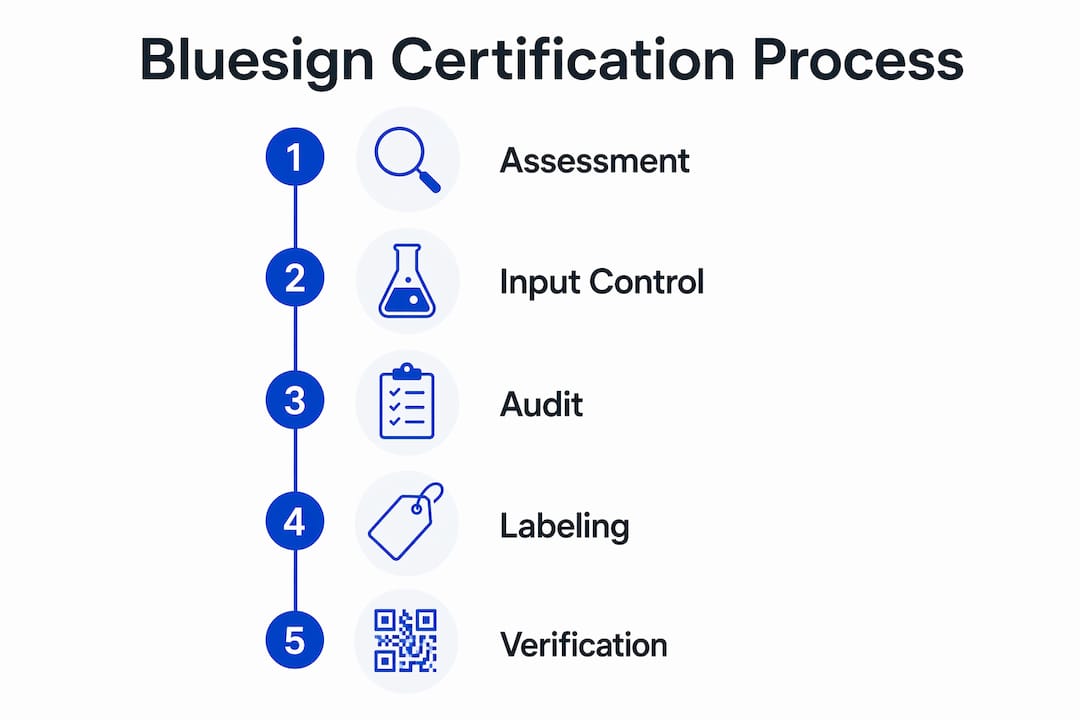
Here’s how the process typically runs:
- Screening — A bluesign expert conducts a full evaluation of the manufacturer’s chemical inventory, water use, energy consumption, and waste streams.
- Input Stream Management (ISM) — Hazardous chemicals are identified and blocked from entering production. Safer alternatives are mapped out.
- On-site assessment — Third-party auditors inspect the facility against bluesign Criteria covering production sites, converters, brands, and chemical assessment.
- Corrective roadmap — The manufacturer receives a gap report and a structured path to compliance.
- Approval and ongoing audits — Once approved, the site undergoes continuous monitoring. System-partner status is not a one-and-done award.
Input Stream Management stops hazardous chemicals from entering the supply chain in the first place, rather than catching them after the fact in finished-product testing. That root-cause approach reduces downstream failures, rework, and the cost of chemical substitution over time.
Bluesign also publishes Restricted Substances Lists (BSSL and BSBL) that define substance limits and priority chemicals used in every assessment. Registered chemicals are searchable through the bluesign Finder tool, and approved materials appear in the bluesign Guide.
Pro Tip: Sourcing managers can use the bluesign Guide and Finder to pre-qualify mills and chemical suppliers before contract negotiations, cutting onboarding time significantly.

How to decode bluesign labels: APPROVED components vs. bluepass finished goods
Bluesign certifies processes and inputs, not factories as standalone entities. What a finished-product mark tells you is that the production behind that item met bluesign Criteria at the component and factory level.
There are two main certification tiers:
- Bluesign APPROVED applies to individual inputs: fabrics, trims, and chemicals that have passed assessment. These appear in the bluesign Guide (for articles and materials) or bluesign Finder (for chemicals). A brand sourcing bluesign APPROVED fabric is buying a verified input, but that alone doesn’t make the finished garment a certified product.
- Bluepass product mark (formerly bluesign PRODUCT) applies to finished consumer goods. To qualify, at least 90% of a garment’s components must be bluesign APPROVED, and the manufacturing facility must also meet bluesign factory criteria. The 2026 bluepass mark adds a QR code linking to verifiable documentation.
| Label | What it certifies | Where to find it | How to verify |
|---|---|---|---|
| Bluesign APPROVED | Individual input (fabric, chemical, trim) | bluesign Guide / Finder | Search by material or chemical name |
| Bluepass product mark | Finished consumer product | On-product label or brand page | Scan QR code or check bluesign.com/verify |
| “Contains bluesign materials” | Some, not all, components are APPROVED | Brand product page | Ask brand for component breakdown |
The middle row in that table is the one most shoppers encounter. The bottom row is worth noting: a brand can truthfully say a product “contains bluesign materials” even when only a fraction of it qualifies.
What bluesign actually achieves, and where it stops
Bluesign lowers chemical, water, and energy impacts in textile production and gives brands third-party verified evidence of those controls. That’s genuinely useful, both for consumer confidence and for brands navigating greenwashing scrutiny. What it is not: a social-audit-only label, an organic-fiber certification, or a guarantee of fair wages.
Core benefits for brands and consumers:
- Safer chemistry in the fabrics touching your skin, verified against the BSSL/BSBL substance limits
- Reduced production rework and chemical waste, which translates to lower long-term manufacturing costs
- Third-party auditable data on inputs and process controls, which holds up to regulatory and media scrutiny
- Operational efficiencies in water and energy use that often offset certification costs over time
Where bluesign’s scope ends:
Bluesign focuses on inputs and production processes. Full factory social audits, worker wages, and raw-fiber organic content sit outside its primary scope. A bluesign-certified fabric can still come from a mill with labor practices that other standards would flag. For those concerns, certifications like Fair Trade or GOTS address different parts of the supply chain.
On cost: initial screening fees, chemical substitution, and capital investment can be significant for manufacturers. The ROI case rests on reduced rework, lower resource consumption, and access to brand contracts that require bluesign compliance. For smaller mills, that payback timeline can stretch.
Pro Tip: Procurement teams should ask suppliers for their bluesign system-partner certificate and cross-reference it against the bluesign Guide before signing a sourcing contract. A supplier claiming bluesign compliance without a verifiable listing is a red flag.
Statistic to know: For a finished garment to carry the bluepass product mark, at least 90% of its components must be bluesign APPROVED, plus the manufacturing facility must meet bluesign factory criteria.
How to shop and verify bluesign-certified products in the U.S.
The rule is simple: look for the bluepass or bluesign label, then verify it. A logo alone is not enough, especially as greenwashing claims multiply. Here’s a practical checklist:
- Check the label or hang tag for the bluepass mark or the text “bluesign APPROVED” or “bluesign PRODUCT.”
- Read the product page carefully. “Contains bluesign materials” and “meets bluesign criteria” are different claims with different thresholds.
- Scan the QR code on the bluepass label (available on 2026-transition products) to access the linked verification evidence.
- Search the bluesign Guide at bluesign.com for the material or article name to confirm it’s listed as APPROVED.
- Use bluesign Finder to check whether a specific chemical or dye used by the brand is registered.
- Ask the brand directly for their system-partner status or a certificate number if no QR code is present.
A few U.S.-specific tips: major outdoor retailers filter by sustainability attributes on their product pages, so searching “bluesign” within a retailer’s site often surfaces certified options faster than browsing. For performance apparel, the bluesign Guide and Finder are the most reliable lookups because they pull from the live system-partner database.
- Try search queries like: “[brand name] bluepass verify” or “[fabric name] bluesign Guide”
- On brand websites, look under “materials” or “sustainability” tabs for system-partner documentation
- For B2B sourcing, request the supplier’s bluesign certificate number and validate it directly at bluesign.com
Which U.S. brands use bluesign materials?
Several well-known U.S. and global brands commonly cited in industry resources use bluesign-certified materials, particularly in outdoor and performance apparel. Patagonia, The North Face, Arc’teryx, and Columbia are among the most frequently referenced in public materials as users of bluesign-approved fabrics and trims. REI, as both a retailer and a co-op brand, has published detailed consumer guidance on bluesign-certified materials and uses them across its own product lines.
To confirm whether a specific brand or product qualifies:
- Check the product page for bluepass or bluesign marks and QR codes
- Search the bluesign Guide for the specific material or article used in that product
- Look for system-partner language on the brand’s sustainability page, which indicates the brand has a formal relationship with bluesign, not just a one-off purchase of approved fabric
- Use bluesign.com/verify or the Guide to cross-reference a certificate number the brand provides
One nuance worth knowing: a brand can source some bluesign APPROVED fabrics without being a formal system partner. System-partner status means a deeper, ongoing compliance relationship. When a brand says “we use bluesign materials,” it’s worth asking which tier that represents.
Common confusions about what a bluesign label actually guarantees
The most important rule of thumb: for a finished garment to carry the bluepass product mark, at least 90% of its components must be bluesign APPROVED, and the factory must also meet bluesign criteria. That dual requirement is what most shoppers and even some sourcing teams miss.
- APPROVED ≠ certified product. A bluesign APPROVED fabric is a verified input. The finished garment only qualifies for the product mark when component provenance and factory compliance are both documented.
- “Contains bluesign materials” is a partial claim. It means some components passed, not that the whole product did. The threshold for the full product mark is the 90% rule.
- The bluepass transition adds accountability. The QR-based verification introduced through the bluepass rollout was designed to meet the EU’s Green Claims requirements for evidence access, which matters for U.S. shoppers buying from global brands.
- Bluesign is not an organic or fair-trade label. It addresses chemistry and process controls, not fiber origin or labor standards.
The one-sentence rule: If the label says bluepass product mark and the QR verifies it, the garment’s production chemistry and process controls have been independently audited. Everything else is a partial claim.
Key Takeaways
Bluesign certification verifies production inputs and processes against strict chemical and resource-use standards, with the bluepass product mark requiring at least 90% bluesign APPROVED components plus factory-level compliance.

| Point | Details |
|---|---|
| Input-first verification | Bluesign restricts hazardous chemicals at the source, not just in finished-product testing. |
| 90% component threshold | A finished garment needs at least 90% bluesign APPROVED components to carry the bluepass product mark. |
| QR verification available | The 2026 bluepass transition adds QR codes linking each product to auditable evidence. |
| Scope has limits | Bluesign covers chemistry and process controls, not organic fiber content or full social audits. |
| Verify before you trust | Use bluesign Guide, Finder, or bluesign.com/verify to confirm any brand’s system-partner status. |
Why bluesign matters more than most shoppers realize
The certification landscape in fashion is crowded, and most labels are easier to print than to earn. What makes bluesign worth paying attention to is the upstream logic: fix the chemistry before it enters the fabric, rather than testing the shirt after it’s been made and hoping the results are clean. That’s a fundamentally different standard of proof.
What I find underappreciated is how useful bluesign is as a sourcing filter, not just a consumer signal. The Guide and Finder tools give procurement teams a pre-vetted shortlist of mills and chemicals that have already cleared a rigorous bar. For brands trying to build a credible sustainability story without fabricating it, that’s a real operational advantage.
The bluepass QR transition is also worth watching. It’s one of the few label changes in fashion that actually increases accountability rather than just refreshing branding. When a QR code links to auditable documentation, the claim becomes testable. That’s the direction the whole industry needs to move.
If you’re shopping for pieces made with verified materials, look for the bluepass mark and scan it. If you’re sourcing, start with the bluesign Guide before you start with a supplier’s pitch deck. And if a brand says “sustainable” without pointing to any third-party verification, ask which standard they mean.
At Room24, sustainability isn’t a footnote. Our swimwear collection and bodysuits are designed with material choices that reflect the same values bluesign represents: fewer harmful inputs, better process controls, and fashion you can feel good wearing.
Authoritative sources and further reading
The claims in this article draw from bluesign’s own published criteria and certification pages, SGS’s bluesign certification service overview, and REI’s consumer-facing explainer. Here are the primary sources worth bookmarking:
- bluesign standards and criteria — the official criteria documents for production sites, converters, brands, and chemicals
- bluepass certification explained — covers the APPROVED and PRODUCT marks, the 90% rule, and the bluepass QR transition
- bluesign FAQs — includes guidance on using the Guide and Finder for verification
- SGS bluesign certification service — third-party auditor overview of the three-step process and what on-site assessments cover
- REI bluesign explainer — the clearest consumer-facing breakdown of what the label means when shopping
For verification, save these directly: bluesign Guide (guide.bluesign.com), bluesign Finder (finder.bluesign.com), and bluesign.com/verify for QR-based product lookups. If you’re sourcing professionally, the bluesign criteria PDF is the technical reference for system requirements.


