


The Fashion Institute of Design and Merchandising closed as an independent college on March 31, 2025, and its degree programs now operate as ASU FIDM under Arizona State University. If you searched for the fashion institute of design and merchandising because you’re deciding where to apply, the short answer is: you apply to Arizona State University, not to a standalone FIDM.
Here’s what matters right now:
- Closure date: FIDM ended all educational operations on March 31, 2025.
- Where programs live now: ASU FIDM, part of ASU’s Herberger Institute for Design and the Arts.
- Records custodian: Parchment holds official transcripts and academic records for former FIDM students.
- Accreditation history: the former FIDM carried WSCUC accreditation with a documented history of scrutiny, while current ASU FIDM programs fall under ASU’s own accreditation.
If you’re a former student, don’t wait to request your transcript. If you’re a prospective applicant, search “ASU FIDM” directly rather than the old FIDM admissions portal, which no longer processes new applications.
Key Takeaways
FIDM closed as an independent institution on March 31, 2025, and its degree programs now operate exclusively as ASU FIDM under Arizona State University.
| Point | Details |
|---|---|
| Closure and transition | FIDM ended operations March 31, 2025; programs continue as ASU FIDM within Arizona State University. |
| Where to apply | Apply through Arizona State University to the ASU FIDM program, not any legacy FIDM portal. |
| Records custodian | Parchment holds official transcripts and records for former FIDM students and alumni. |
| Degrees now offered | ASU FIDM offers a BA in Fashion, a BFA in Costume Design and Technology, and a fashion minor. |
| Campus locations | Classes run in Los Angeles and Downtown Phoenix, each offering different industry or university resources. |
Table of Contents
- What Happened to the Fashion Institute of Design and Merchandising?
- What Degrees and Campuses Does ASU FIDM Offer?
- How Do You Apply, and What Changed for Financial Aid?
- Accreditation, Transcripts, and What Alumni Should Do Next
- How Does ASU FIDM Compare to Other Fashion Schools?
- What Careers Do ASU FIDM Graduates Pursue?
- What Should a Sustainable Fashion Brand Look for in Fashion Education?
- Where to Verify FIDM and ASU FIDM Details
- Frequently Asked Questions
- Sources
What Happened to the Fashion Institute of Design and Merchandising?
FIDM’s path to closure didn’t happen overnight. It followed a multi-year arc that started with a partnership announcement and ended with a full institutional wind-down.
- 2023: Arizona State University and FIDM announced a partnership, reported by the Los Angeles Times as a move to stabilize FIDM’s academic and financial future.
- 2023 to 2025: FIDM operated under a transitional model while ASU absorbed curriculum, staffing, and facility elements into what became ASU FIDM.
- March 31, 2025: FIDM formally closed as an independent institution, ending nearly six decades of operation since its founding in 1969.
Why did this happen? Financial instability at the private, for-profit institution combined with accreditation concerns tied to a WSCUC review created real risk that FIDM could shut down with no landing spot for students. The ASU partnership addressed both problems at once: it gave FIDM programs institutional stability and folded them into ASU’s own accreditation framework, according to LA Times reporting.
For students who were enrolled during the transition, credits and coursework generally carried forward into ASU FIDM’s structure, though the specifics depend on when you attended and which program you were in. Recent alumni should treat this as a records issue first: your diploma is valid, but the institution that issued it no longer exists as a standalone entity.
Pro Tip: If you attended FIDM any time in the last five years, request your official transcript from Parchment now, even if you don’t need it yet. Records requests tend to slow down months after a closure once staff transition to new roles, so early is better than urgent.
What Degrees and Campuses Does ASU FIDM Offer?
ASU FIDM’s current lineup is narrower than the old FIDM catalog, which offered a wide range of associate degrees. The ASU FIDM degree programs page lists three core options for the 2025 to 2026 academic year:
- Bachelor of Arts in Fashion — a four-year degree covering design, merchandising fundamentals, and industry business practices.
- Bachelor of Fine Arts in Costume Design and Technology — built for students aiming at film, television, theater, or live entertainment costume work.
- Minor in Fashion — for ASU students in other majors who want fashion coursework without a full degree switch.
Classes run in two locations: Los Angeles, where FIDM’s original campus sat close to the garment district and major studio lots, and Downtown Phoenix, where students get direct access to ASU’s broader university resources. That geographic split matters practically. LA gives you proximity to working designers, costume houses, and retail buyers. Phoenix gives you research libraries, cross-disciplinary electives, and a bigger student population.
Curriculum leans on studio work and a capstone project rather than lecture-heavy theory, continuing a hands-on approach the original FIDM built its reputation on. Sustainability and technical merchandising tracks show up as elective options within the BA in Fashion.
Former FIDM held a fashion museum and archive with a permanent costume and textile collection that supported classroom teaching and public exhibitions for decades. Whether and how those archival resources continue under ASU is worth confirming directly with the program if archival access factors into your decision.
How Do You Apply, and What Changed for Financial Aid?
Applying to ASU FIDM means applying through Arizona State University’s admissions system, not any legacy FIDM portal. That single fact trips up a lot of prospective students still finding old FIDM pages in search results.
Here’s the practical sequence:
- Apply to Arizona State University, selecting the ASU FIDM program under the Herberger Institute for Design and the Arts.
- Submit a portfolio if required for your intended track, particularly for the Costume Design and Technology BFA.
- Request transfer evaluation if you have prior FIDM coursework or credits from another institution.
- Order transcripts through Parchment if you need them for transfer credit review or employer verification.
- Confirm deadlines directly with ASU FIDM admissions, since timelines can differ from ASU’s general undergraduate calendar.
The financial aid shift is the part most worth pausing on. FIDM operated as a private, for-profit college, which limited certain federal aid pathways. ASU FIDM operates under a public university’s aid framework, which opens up federal financial aid options that weren’t available to students at the old institution. If cost was ever a reason you ruled out FIDM, it’s worth reconsidering ASU FIDM on that basis alone.
Pro Tip: Request your transfer credit evaluation before you finalize course registration. Advisors can only map legacy FIDM credits accurately once they have your full transcript in hand, and starting that process late can push your first semester schedule around.
Accreditation, Transcripts, and What Alumni Should Do Next
The former FIDM held accreditation through WSCUC, with a documented history that included periods of formal concern over institutional sustainability. That history is part of why the ASU partnership happened in the first place. ASU FIDM’s programs now fall under Arizona State University’s own accreditation, which resolves the uncertainty that surrounded FIDM in its final years.
Parchment serves as the custodian of records for anyone who attended the former FIDM. If you’re an alum trying to verify a degree or pull a transcript, here’s the step-by-step:
- Go to Parchment’s platform and search for FIDM as your former institution.
- Order an official transcript, specifying the recipient (employer, grad school, licensing board).
- Keep a personal copy of any diploma, transcript, or enrollment verification you already have, since institutional transitions occasionally create processing delays.
- Contact ASU FIDM directly if Parchment can’t locate your specific records.
Employers and credential evaluators generally treat ASU FIDM degrees as standard ASU credentials, since ASU’s accreditation now governs the program. Legacy FIDM degrees remain valid based on WSCUC accreditation at the time they were issued, even though the institution itself no longer operates independently. That distinction is one you may need to explain to an employer or evaluator unfamiliar with the transition, and having your transcript in hand makes that conversation far easier.
How Does ASU FIDM Compare to Other Fashion Schools?
Prospective students weighing ASU FIDM against other options should look at a few concrete dimensions rather than reputation alone: institutional status, degree depth, campus access, accreditation clarity, financial aid, curriculum focus, and career network strength.
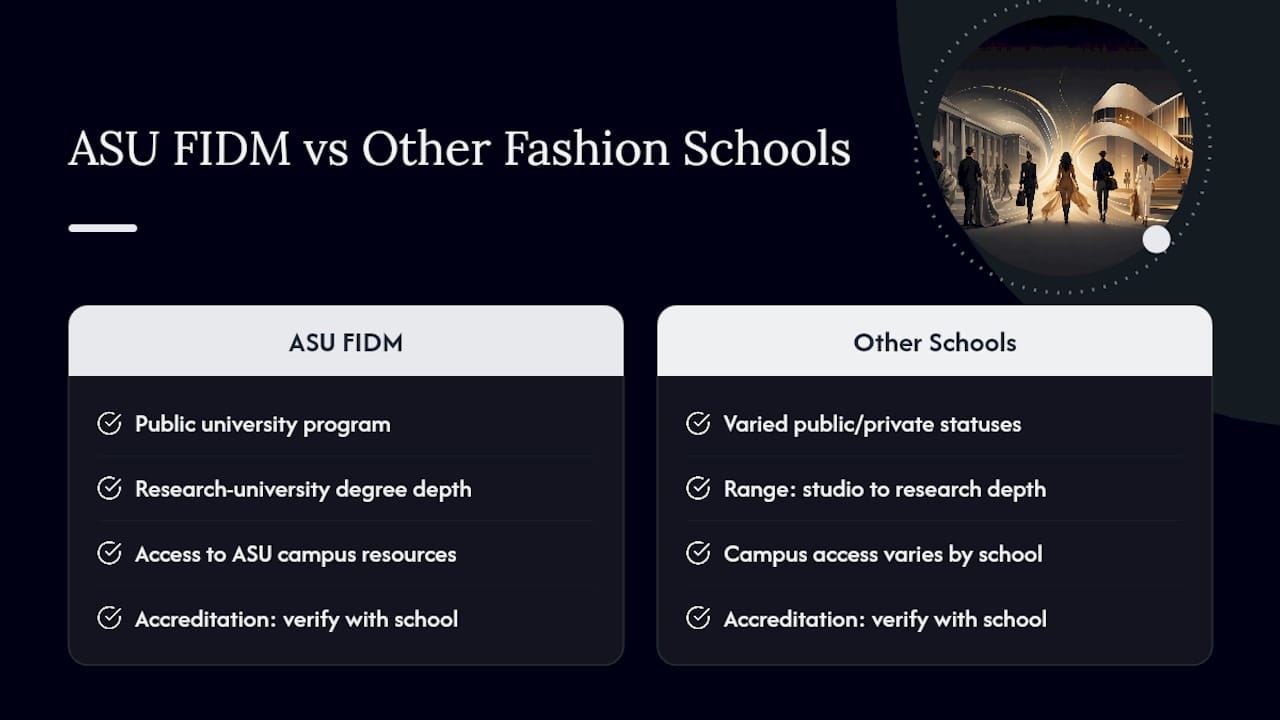
ASU FIDM’s biggest structural change from the old FIDM is its status as a public university program rather than a private for-profit college. That shift alone affects federal aid eligibility, tuition structure, and long-term institutional stability. On curriculum, ASU FIDM keeps FIDM’s hands-on, industry-oriented training model, and layers on access to a research university’s broader resources, including cross-disciplinary electives and Herberger Institute programming.
Peer institutions worth knowing as reference points include Parsons School of Design and the Fashion Institute of Technology (FIT) in New York, the School of the Art Institute of Chicago (SAIC), and Central Saint Martins and the London College of Fashion, both part of University of the Arts London (UAL). Each takes a different balance of hands-on studio work versus theory and research, and each carries its own accreditation and career-network profile. None of these comparisons should be read as a ranking. They’re reference points to help you weigh what actually matters for your goals: cost and aid structure, research opportunities, internship density, and international reputation.
The core trade-off for any applicant comparing fashion programs is between industry-immersion training and research-university infrastructure. ASU FIDM is one of the few programs now offering meaningful access to both.
Verify any specific claim about a program directly with that institution’s admissions office. Accreditation status, curriculum details, and aid eligibility change, and a school’s own current pages are always more reliable than a general list.
What Careers Do ASU FIDM Graduates Pursue?
Fashion and costume design graduates typically land in a handful of recognizable lanes: design studios, technical garment roles, merchandising and buying positions, costume departments for film and theater, sustainability-focused roles at apparel brands, and independent entrepreneurship.

ASU FIDM’s dual-campus structure gives students a real advantage here. Los Angeles proximity puts you near working studios, showrooms, and manufacturers. ASU’s broader career services network adds structured internship placement and alumni connections that a smaller standalone college often can’t match.
A practical checklist for building employability while enrolled:
- Start your portfolio in your first year, not your final semester.
- Pursue at least one internship before your junior year if your program allows it.
- Network through ASU career fairs and industry events, not just classroom contacts.
- Highlight sustainability and technical skills on your resume. Employers increasingly screen for both.
- Ask advisors directly how curriculum changes from the legacy FIDM catalog affect your internship credit or capstone requirements, since specifics vary by cohort.
Technical patternmaking, garment construction, and merchandising analytics remain the skills recruiters ask about most, regardless of which fashion program a candidate attended.
What Should a Sustainable Fashion Brand Look for in Fashion Education?
Room24 builds sculpting silhouettes and signature cut-outs using sustainable materials, which means we care about where the next generation of designers learns their craft. Program prestige matters less to us than whether a curriculum actually teaches technical patternmaking, garment construction, and the kind of sustainability literacy that shows up in real production decisions, not just a single elective.
What we’d tell any applicant weighing fashion institute of design and merchandising programs, including ASU FIDM, is to ask pointed questions about studio hours, materials sourcing coursework, and whether sustainability shows up as a core thread or a side offering. Our own approach to mindful production reflects what we think strong design education should build toward: technical skill paired with material accountability. If you want to see how that philosophy shows up in an actual product line, our loungewear collection is built on the same cut-and-fit principles that a strong costume or fashion program should be teaching in the studio.
Programs that treat sustainable material science as an afterthought are producing graduates who’ll need to relearn on the job. That’s a real cost, whether the school is ASU FIDM, Parsons, or FIT.
Where to Verify FIDM and ASU FIDM Details
Confirm anything in this article directly with the primary sources below before making an application or transcript decision.
- ASU FIDM alumni page for closure details and alumni resources.
- ASU FIDM degree programs page for current program requirements.
- LA Times coverage of the ASU-FIDM partnership for background on why the merger happened.
- Archived FIDM about page for records custodian details and institutional history.
- AACC institutional listing for FIDM for basic historical verification.
Frequently Asked Questions
Is the Fashion Institute of Design and Merchandising still open? No. FIDM closed as an independent institution on March 31, 2025. Its former programs now operate as ASU FIDM under Arizona State University.
How do I get my FIDM transcript? Request it through Parchment, which serves as the official custodian of records for former FIDM students and graduates.
Can I still apply to FIDM? Not directly. You apply to Arizona State University and select the ASU FIDM program within the Herberger Institute for Design and the Arts.
Does ASU FIDM offer the same degrees as the old FIDM? Not exactly. ASU FIDM currently offers a Bachelor of Arts in Fashion, a Bachelor of Fine Arts in Costume Design and Technology, and a fashion minor, a narrower lineup than FIDM’s former associate degree catalog.
Will my FIDM credits transfer to ASU FIDM? Many do, but transfer evaluation depends on your specific coursework and timing. Contact ASU FIDM academic advisors directly with your transcript in hand.
Sources
- ASU FIDM | FIDM alumni
- ASU FIDM degree programs
- Arizona State University fashion program merges with L.A.'s FIDM - Los Angeles Times
- FIDM — About (archival)
- Fashion Institute of Design & Merchandising - AACC (nche.edu)


